
The world of fine jewellery is undergoing a profound transformation. While the allure of a shimmering gemstone remains timeless, the methods used to create these treasures are evolving. Today, the art of jewellery manufacturing is no longer defined solely by traditional mining; it is being redefined by the precision of science and the ethics of sustainability.
At the heart of this revolution is the lab-grown diamond. By combining age-old artisanal techniques with cutting-edge technology, modern producers are creating pieces that are physically, chemically, and optically identical to mined diamonds, but with a significantly lower environmental footprint.
1. The Genesis: Cultivating the Perfect Diamond
The jewellery manufacturing process begins long before a jeweler touches a metal saw. In the case of lab-grown diamonds, the “art” starts in a controlled laboratory environment that mimics the intense heat and pressure of the Earth’s mantle.
The Two Primary Methods:
- Chemical Vapor Deposition (CVD): This process uses a thin “seed” of a diamond placed in a vacuum chamber. Carbon atoms layer themselves onto the seed, growing the diamond atom-by-atom.
- High Pressure High Temperature (HPHT): This method subjects carbon to extreme pressure and temperatures exceeding 1,500°C, recreating the natural conditions that form diamonds deep underground.
Unlike mass-produced synthetic materials, growing a high-quality lab diamond is an unpredictable art form that requires expert technicians to monitor the crystal lattice.
2. Design and Conceptualization: From Sketch to CAD
In modern jewellery manufacturing, the design phase bridges the gap between a designer’s imagination and technical reality.
- Hand Sketching: Most high-end pieces begin with a pencil sketch to capture the flow and spirit of the piece.
- Computer-Aided Design (CAD): Once the sketch is finalized, it is converted into a 3D digital model. CAD allows for microscopic precision, ensuring that the prongs are strong enough to hold the stone while allowing maximum light to enter.
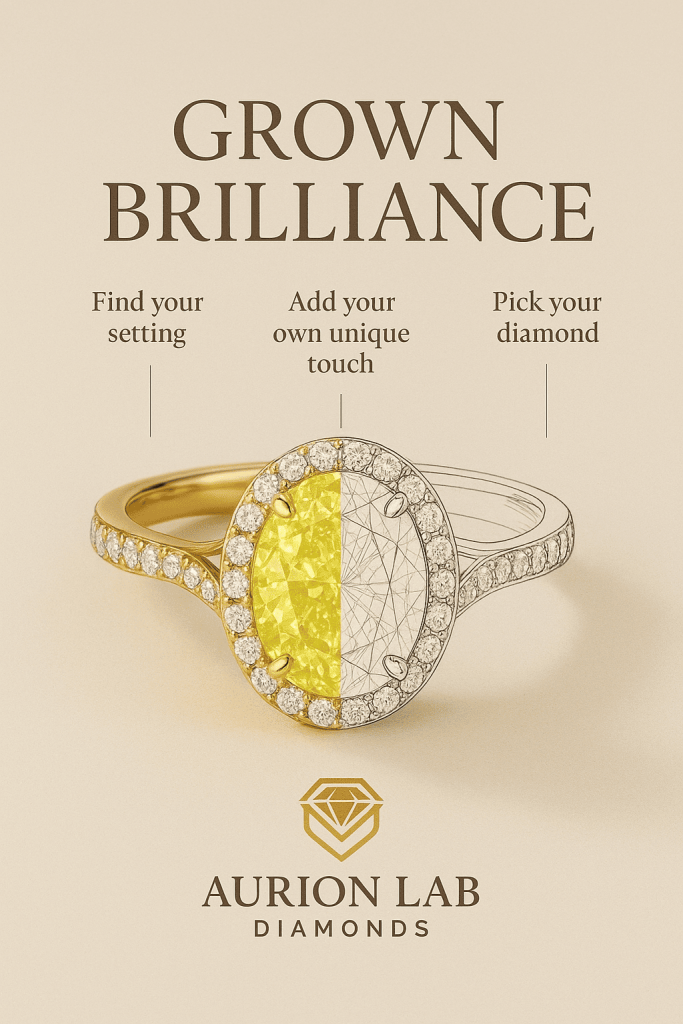
- 3D Printing (Prototyping): Before any gold is melted, a resin model is printed. This allows the designer to check the scale and comfort of the piece.
3. The Metallurgy: Crafting the Canvas
The preparation of the metal is a delicate process within the jewellery manufacturing workflow. Whether it is 18K gold or platinum, the metal must be perfect to hold a high-quality stone.
- Alloying: Pure gold is mixed with alloys (like copper, silver, or palladium) to create durable 14K or 18K gold.
- Lost-Wax Casting: This ancient technique remains an industry standard. A molten metal is poured into a cavity created by the 3D-printed model, forming the jewellery’s raw frame.
4. The Lapidary Art: Cutting for Maximum Fire
While lab-grown diamonds are “born” in a lab, they are “made” on the cutting wheel a crucial step in fine jewellery manufacturing. A rough diamond looks like a cloudy pebble until it reaches the hands of a master cutter.
The cutter must analyze the rough stone to determine the best shape be it a classic Round Brilliant or a sophisticated Emerald cut. The precision of the facets determines how light travels through the stone, creating the “fire” and “scintillation” that makes a diamond breathtaking.
5. Setting the Stage: The Master Setter’s Touch
Setting a lab-grown diamond is perhaps the most nerve-wracking stage of jewellery manufacturing. It requires a steady hand and a microscope.
- Prong Setting: Allows the diamond to sit high and catch the light.
- Pavé Setting: Tiny diamonds are set closely together, held by microscopic beads of metal.
- Bezel Setting: The metal surrounds the diamond entirely for a modern look and maximum protection.
The setter must apply just enough pressure to secure the stone without damaging the metal or the gem. It is a balance of strength and finesse.

6. Polishing and Finishing: The Final Radiance
The final step in jewellery manufacturing is the “finishing,” where the piece undergoes multiple stages of polishing. Using various buffs and polishing compounds, the jeweler removes any microscopic scratches from the casting process.
- Rhodium Plating: For white gold, a final dip in rhodium provides that signature mirror-like, bright white finish.
- Quality Control: Every piece is inspected under a 10x loupe to check stone security, edge smoothness, and the integrity of the hallmarks.
7. The Ethical Advantage: Why Lab-Grown Matters
The true “art” of modern jewellery manufacturing isn’t just in how it looks, but in what it represents. By choosing lab-grown diamonds, the jewellery manufacturing process becomes:
- Conflict-Free: There is a 100% guarantee of origin.
- Environmentally Conscious: Significantly less land disturbance and water usage than traditional mining.
- Accessible Luxury: A shorter supply chain allows for higher-quality stones at better value.
Conclusion: A New Era of Brilliance
The art of jewellery manufacturing is a symphony of science, history, and craftsmanship. By integrating lab-grown diamonds into this tradition, we are not replacing the past; we are perfecting the future.
When you wear a lab-grown diamond, you are wearing a masterpiece of modern alchemy. Each piece is meticulously crafted to last a lifetime through our advanced jewellery manufacturing techniques.
Ready to Find Your Sparkle? Explore our latest collection of ethically crafted, high-precision lab-grown diamond jewellery today.